
SEO — Getting Found
A beautiful website is not enough — people must be able to find it.
SEO (Search Engine Optimization) is the practice of structuring and writing a website so search engines can understand it, trust it, and rank it well. It’s a combination of technical correctness, content quality, and user experience working together.
Beginner Explanation
SEO isn’t a single trick; it’s a combination of technical correctness, content quality, and user experience, all working together. Page titles (the <title> tag) are one of the strongest on-page ranking signals and also the headline shown in search results — every page should have a unique, descriptive title that reflects what a searcher will actually find there. Meta descriptions are the short summary shown beneath a page’s title in search results; they don’t directly affect ranking, but a well-written one significantly affects click-through rate.
Keywords are the actual words and phrases people type into search engines. Effective SEO starts with understanding what your real customers search for, then naturally incorporating that language into titles, headings, and body content — not by unnaturally stuffing keywords in, which modern search algorithms are specifically designed to penalize. Fast loading and mobile-friendly design are now core, direct ranking factors rather than "nice to haves" (Chapter 13) — because most searches now happen on mobile, Google evaluates the mobile version of a site as the primary version for ranking.
A Google Business Profile is a free, business-owned listing that appears in Google Search and Maps, showing hours, reviews, photos, and location — for any business serving a local area, a complete, actively-managed profile is often one of the single highest-impact SEO actions available. Structured data (schema markup) is a standardized code format that explicitly tells search engines what specific pieces of content mean, unlocking rich results and helping AI-powered search tools correctly cite a website’s content.
Real Business Examples
A unique title per page
"Emergency Plumber in Sandton | Sipho’s Plumbing" tells both Google and a searcher exactly what that page offers and where — far stronger than a generic "Home" title repeated on every page.
Google Business Profile
A free, business-owned listing showing hours, reviews, and location — often the very first thing a "plumber near me" searcher sees, before they even click through to the website.
Structured data (schema markup)
Explicitly tells search engines "this is a review," "this is a local business with these opening hours" — unlocking star ratings and FAQ dropdowns directly in search results, and helping AI search tools cite the business correctly.
Visual Diagram
What actually drives ranking
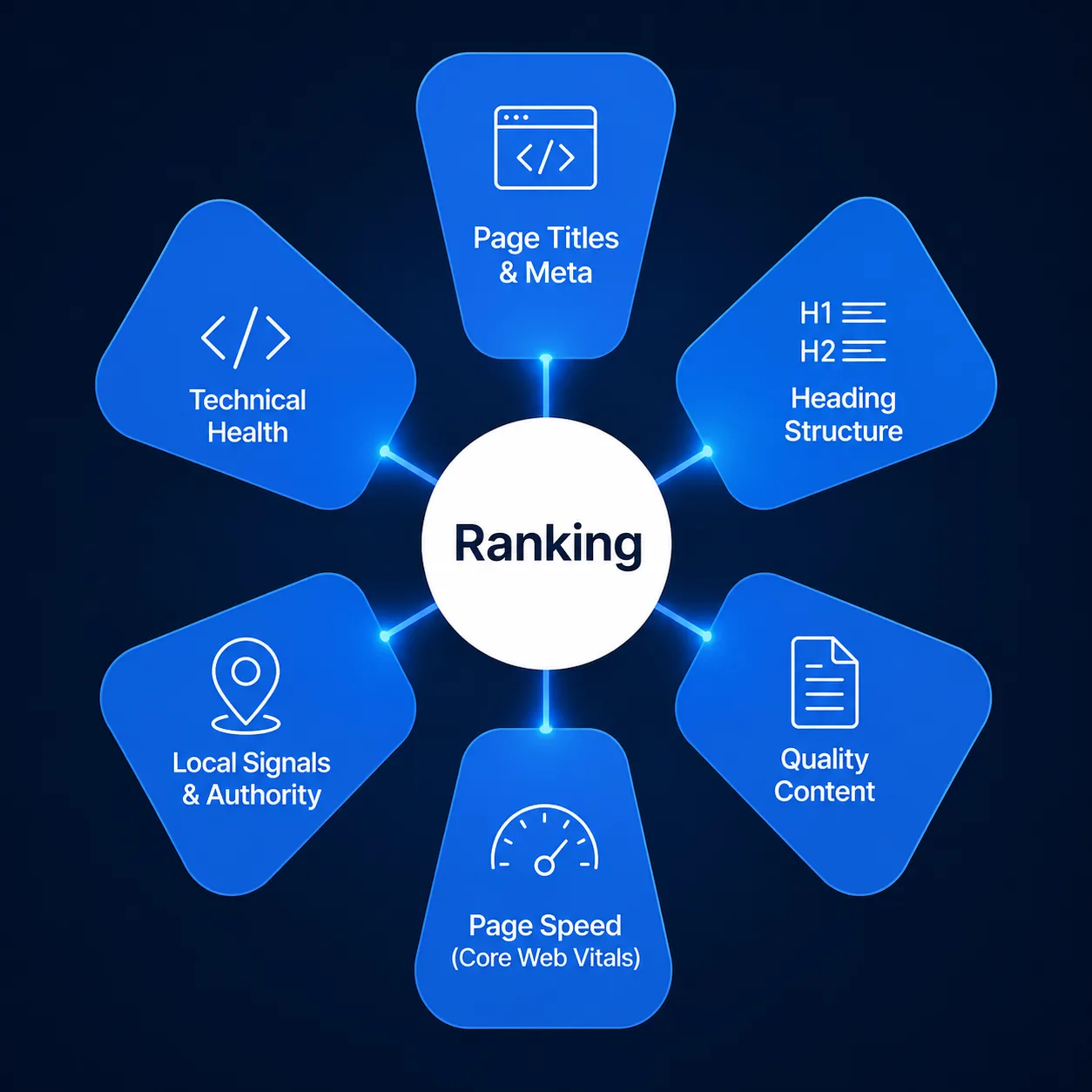
- Unique, descriptive page titles & meta descriptions
- Clean heading structure (h1 → h2 → h3, from Chapter 2)
- Genuinely useful, keyword-relevant content
- Fast loading + mobile-friendly design (Chapter 13)
- Active Google Business Profile + reviews
- Structured data for rich results
Common Mistakes
- Using the same generic page title ("Home", "Services") across every page instead of unique, descriptive ones.
- Keyword stuffing — unnaturally repeating phrases, which modern search algorithms are specifically designed to penalize.
- Treating SEO as a final checklist item added right before launch, instead of a discipline woven through every earlier phase.
- Ignoring mobile experience — Google evaluates the mobile version of a site as the primary version for ranking.
Tools to Use
Google Search Console
Free tool showing exactly how Google sees and ranks your site.
Google Business Profile
Free local listing management — hours, reviews, photos, map presence.
Google PageSpeed Insights
Measures the Core Web Vitals that directly affect both ranking and Chapter 13’s performance work.
Schema Markup Generator
Free tools to generate structured data for reviews, local business info, and FAQs.
Key Takeaways
- Unique page titles and meta descriptions directly influence both ranking and click-through rate.
- Mobile-friendliness and page speed (Core Web Vitals) are direct, measurable ranking factors, not optional extras.
- A complete, active Google Business Profile is one of the highest-impact actions for local businesses.
- Structured data helps both traditional search rankings and, increasingly, AI-powered search tools understand and cite your content correctly.
Practical Exercises
- Pick any page from a practice site and write a unique, keyword-relevant page title (under 60 characters) and meta description (under 160 characters), phrased the way a real searcher would search.
- Claim or review a Google Business Profile for a fictional local business and list three things you’d fill in first.
Want "SEO — Getting Found" done for you, not just explained?
We build fast, mobile-first websites for South African local businesses — putting everything in this chapter into practice, professionally.